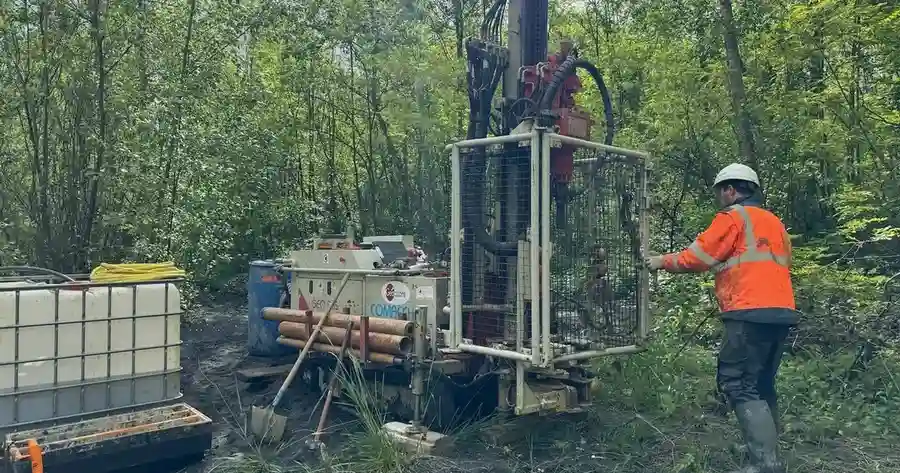
Sinking a foundation in Long Beach without understanding the transition from Holocene alluvium to older Pleistocene terrace deposits is a recipe for differential settlement. We have seen projects in the Wrigley area move forward on soils assumed to be uniform marine sand, only to hit pockets of organic silt at depth that standard site reconnaissance missed. A soil mechanics study resolves this grey area before the concrete is placed. Our laboratory determines effective friction angles, compressibility indices, and consolidation history on Shelby tube samples recovered from your site. The output is not just numbers—it is a defensible bearing stratum recommendation that accounts for the high groundwater table typical south of Willow Street. We cross-check field SPT blow counts with triaxial CU tests to confirm shear strength parameters that structural engineers can actually use in their foundation models.
Long Beach soils change drastically over a distance of two miles—what works on the Signal Hill terrace will not hold on the back-barrier marsh deposits of Belmont Shore.
Common questions
How much does a soil mechanics study cost in Long Beach?
For a typical commercial lot in Long Beach, a complete soil mechanics study with one boring to 50 feet, SPT sampling, and a full suite of index and triaxial tests runs between US$3,130 and US$4,770. The final cost depends on the number of borings, depth, groundwater monitoring requirements, and whether cyclic triaxial testing for liquefaction assessment is needed.
Which ASTM standards apply to a soil mechanics study in California?
The core standards are ASTM D1586 for SPT sampling, ASTM D2487 for soil classification, ASTM D4767 for consolidated-undrained triaxial testing, and ASTM D2435 for consolidation properties. The IBC and ASCE 7 govern how the results feed into foundation design and seismic hazard evaluation.
How long does lab testing take once the boring is complete?
Standard index tests (moisture, Atterberg, grain size) are completed within 5 to 7 business days. Consolidation and triaxial tests require longer curing and shearing times, typically 10 to 14 business days. We can expedite select tests if the contractor is waiting on a foundation submittal.
Do I need a soil mechanics study if my project already has a geotechnical report?
A geotechnical report often includes field logging and SPT data, but a dedicated soil mechanics study provides the laboratory-derived strength and compressibility parameters that structural engineers need for detailed foundation design. If the original report only provides presumptive bearing values without lab backing, a follow-up study is strongly recommended for any structure exceeding two stories.