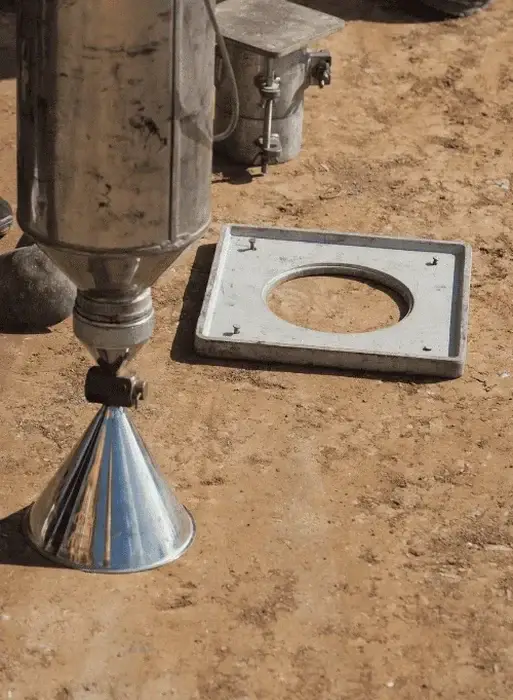
Out here in Long Beach, you can have two lots on the same street that behave completely differently. One sits on relatively stiff Pleistocene terrace deposits, the other on liquefiable fill over the old floodplain of the Los Angeles River. That contrast is exactly why a standard Proctor curve means nothing until you verify it in the field. The sand cone method—ASTM D1556—remains the most direct way to do that on compacted backfill, utility trenches, and building pads across the city. We run these tests daily from Naples Island to Bixby Knolls, and the results consistently save contractors from costly over-excavation or failing a City inspector’s nuclear gauge spot check. When the soil is silty sand with shells mixed in—common near the coast—a CPT test can map the stratigraphy beforehand so you know exactly where the fill transitions to native material before density testing begins.
A passing sand cone test in Long Beach means the soil at that exact spot, at that exact depth, meets the project specification—something a nuclear gauge can miss if the source rod hits a gravel pocket.
How we work
The kit itself is straightforward but unforgiving if calibration slips: a one-gallon threaded jar filled with clean, dry, uniformly graded Ottawa sand (ASTM C778), a cone baseplate with a 6.5-inch opening, and a weigh scale readable to 1 gram. In Long Beach, we pre-calibrate the sand bulk density that same morning because humidity from the marine layer can add half a pound per cubic foot to your sand weight by noon. The technician excavates roughly 4 to 6 inches of material through the baseplate, weighs every gram removed, then fills the void with sand from the jar. Wet density is calculated on the spot, and a Speedy moisture tester gives the water content within minutes—critical when you are compacting decomposed granite that looked dry during grading but absorbed moisture overnight. For larger commercial pads east of the 710, where fill lifts exceed twelve inches, we often pair the sand cone with a
plate load test to confirm the modulus of the finished subgrade directly under the expected bearing pressure. On deep urban excavations where shoring is active, real-time
excavation monitoring provides the lateral movement data needed to keep the density-testing crew safe while they work adjacent to the retaining system.
Common questions
What does a field density test using the sand cone method typically cost in Long Beach?
For a standard sand cone test in the Long Beach area, expect to budget between US$110 and US$150 per individual test point. The final rate depends on site accessibility, the number of tests scheduled in a single visit, and whether expedited same-day reporting is required. A multi-point grid across a commercial site usually brings the per-test cost toward the lower end of that range.
How long does one sand cone density test take on-site?
A single test, including baseplate setup, excavation, sand filling, and moisture determination with a Speedy meter, takes about 20 to 25 minutes on a prepared lift. The technician can usually run four to five tests per hour if the compaction equipment is not actively working in the immediate test area. The report is generally available as a digital PDF within hours of completing the field work.
Can the sand cone be used on aggregate base rock or only on soil?
The sand cone method works reliably on aggregate base with nominal particle sizes up to about 1.5 inches, provided the technician excavates a sufficiently large test hole to minimize error from individual stones. For open-graded base rock with larger voids, a water replacement method or a calibrated nuclear gauge backed by sand cone correlation may be more appropriate. Our field lead will recommend the method after reviewing the gradation report for your imported material.