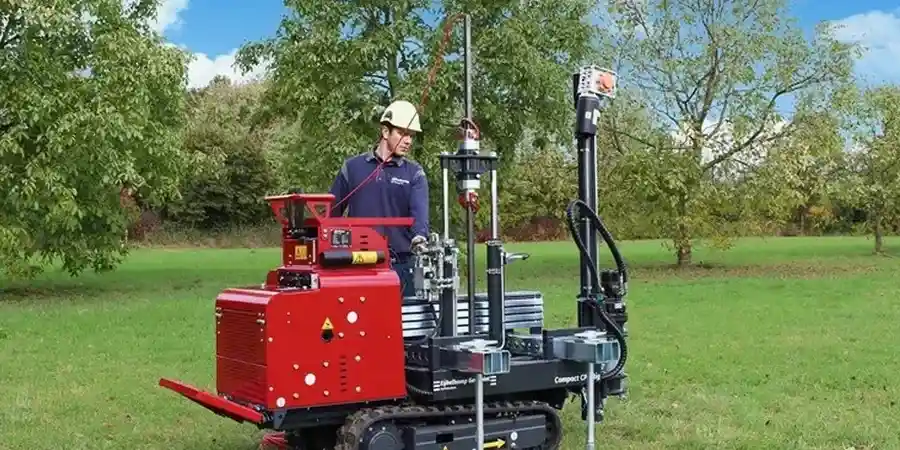
The 2019 update to ASCE 7-16 and the California Building Code now require a more rigorous seismic site classification for structures within 5 miles of active faults, which directly impacts most commercial projects in Long Beach. A standard SPT boring often struggles to capture the subtle layering of young alluvium and loose hydraulic fills beneath the port area, leading to conservative over-design. We apply high-resolution cone penetration testing to record continuous tip resistance and sleeve friction, eliminating the 5-foot gaps that can hide a thin, liquefiable silt seam. This method anchors your foundation calculations to a near-continuous stratigraphic log, helping structural engineers optimize footing dimensions and avoid unnecessary deep foundations. For projects near the LA River outlet or the Terminal Island Freeway corridor, integrating CPT data with a liquefaction screening analysis becomes a straightforward step rather than a costly re-interpretation.
Continuous CPT data reduces the uncertainty in seismic site classification on Long Beach's interbedded estuarine soils, directly lowering the foundation over-design factor.
How we work
Long Beach sits near sea level, with much of the downtown core resting on late Holocene deposits less than 10,000 years old, which means we frequently encounter compressible clays interbedded with sand lenses. A friction-cone penetrometer with a 60-degree apex angle advances at a constant 2 cm/s rate, measuring pore pressure dissipation alongside mechanical resistance, and we log these parameters every centimeter. The resulting friction ratio (Rf) allows us to classify soil behavior type directly from the CPTu data, distinguishing dense sand from stiff clay without the sample disturbance that plagues split-spoon recovery. When the project footprint extends into older uplifted terraces near Signal Hill, we often combine CPT soundings with a
seismic refraction survey to map the depth to the Pliocene Fernando formation, which provides a marked impedance contrast. For shallow foundation design on the sandy loams common east of the 710, many engineers pair this data with a
plate load test to calibrate bearing capacity predictions against direct field measurements.
Local geotechnical context
In Long Beach, we often see older warehouse conversions near the LA River where the geotechnical report relies solely on SPT blow counts from a 1980s investigation, completely missing the presence of a thin, loose silt layer at 12 feet that saturates during a 100-year storm event. A single CPT sounding across those foundations can reveal a dramatic drop in tip resistance that correlates to a post-peak strength loss under cyclic loading, a failure mechanism that a standard boring would never catch. The biggest financial exposure isn't the cost of testing — it's the unplanned dewatering and shoring redesign when excavation hits an undetected artesian pocket or a lens of organic peat. Our team ties every CPT log to the IBC Chapter 18 geotechnical investigation requirements, ensuring the data package supports a defensible seismic design category without triggering a plan-check rejection from the City of Long Beach Building and Safety Bureau.
Common questions
What is the typical cost of a CPT sounding in Long Beach?
For a standard CPTu sounding to 15 meters (50 feet) with a 20-ton rig, the cost ranges from US$160 to US$210 per meter mobilized, depending on the number of soundings and the accessibility of the site. A minimum mobilization fee often applies for a single sounding.
How long does a CPT test take compared to a standard boring?
A single CPT sounding to 20 meters typically takes 45 to 90 minutes of penetration time, plus about 30 minutes for rig setup and calibration. This is significantly faster than a hollow-stem auger boring, which can take half a day to reach the same depth when you account for sampling and casing.
Can CPT replace all my borings for a mixed-use building in downtown Long Beach?
Not entirely. CPT provides continuous stratigraphy and excellent liquefaction data, but you still need at least one soil boring to collect samples for laboratory index testing (Atterberg limits, moisture content). The IBC allows a hybrid approach where one boring and several CPT soundings provide a more complete picture than all borings alone.
Do you hit refusal on the gravelly soils near the San Gabriel River?
In the coarser alluvial fan deposits near the eastern city limit, we can encounter refusal on dense gravel lenses. We monitor the cone tip stress in real time and stop at 100 MPa to protect the electronics. In those cases, we switch to a SPT drilling program for that specific location to penetrate the gravel and continue the investigation.
Is CPT data accepted by the City of Long Beach plan check engineers?
Yes. The City of Long Beach Building and Safety Bureau accepts CPT data for site characterization and liquefaction analysis when it's performed under the supervision of a California-licensed geotechnical engineer and reported in accordance with ASTM D5778. We format all deliverables to meet the specific digital submission requirements for the Southern California region.