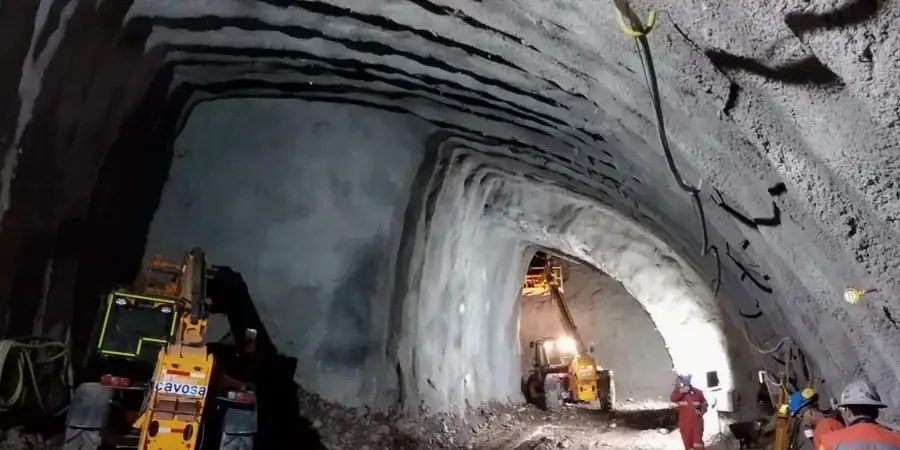
A tunnel boring machine’s cutterhead can chew through hard rock, but in Long Beach it faces a different beast: the young, compressible sediments of the Los Angeles Basin. Our analysis starts where the USGS Quaternary alluvium maps leave off. We characterize the fine-grained estuarine deposits and the San Pedro Sands that dominate the subsurface down to 150 feet. Before a single ring is erected, we quantify undrained shear strength and consolidation parameters on undisturbed Shelby tube samples. The Port of Long Beach sits on artificial fill over these very deposits; any alignment crossing the Terminal Island Freeway or the Alameda Corridor must account for differential settlement and face pressures that change block-by-block. Pairing this with CPT testing gives us a continuous stratigraphic profile without gaps, essential when the tunnel crown sits within a transitional zone between clay and silty sand.
In saturated soft ground, face pressure is not a setting—it is a survival parameter calibrated from high-quality lab data.
How we work
Long Beach sits barely 30 feet above sea level, with groundwater commonly encountered at depths of 10 to 15 feet. That changes the tunneling game completely. Our geotechnical analysis models the effective stress regime under two-phase flow conditions, because a TBM in saturated soft ground behaves more like a submarine than a mining operation. We run consolidated-undrained triaxial tests at in-situ confining pressures, and our lab—accredited under ISO 17025 through A2LA—generates the critical-state parameters needed to define the failure envelope. The analysis also incorporates the Wilmington Anticline’s influence: subtle structure, but enough to tilt bedding planes and create asymmetric loading on the lining. We feed these inputs into 2D and 3D finite-element models that predict surface settlement troughs under Los Angeles County’s strict deformation criteria, protecting the nearby Port infrastructure and the dense network of oil pipelines that crisscross the harbor district.
Local geotechnical context
IBC 2022 Section 1810 and ASCE 7-22 seismic provisions carry particular weight in Long Beach, where the Newport-Inglewood Fault runs just offshore. A tunnel in soft soil doesn’t just shake—it can oval, rack, or float upward during a design-level event. Our analysis quantifies free-field shear strains and imposes them on the tunnel lining via soil-structure interaction springs calibrated to G-γ modulus reduction curves. The 1933 Long Beach earthquake taught us that unconsolidated sediments amplify ground motion; we apply site-specific response spectra rather than generic site class D defaults. Liquefaction-induced buoyancy is evaluated using Seed & Idriss triggering procedures, and if the factor of safety drops below 1.1, we design ground improvement or ballast strategies. Ignoring the seismic component in saturated soft ground is not a risk—it is a guarantee of service-life reduction.
Common questions
What is the typical cost range for a geotechnical analysis of a soft soil tunnel alignment in Long Beach?
The scope varies with tunnel length and depth, but for a preliminary to final design package including lab testing, analysis, and reporting, projects typically range from US$4,140 to US$17,770. A detailed proposal is tailored to the alignment after reviewing the geotechnical baseline report requirements.
How does the high groundwater in Long Beach affect tunnel design?
Groundwater at 8 to 15 feet creates a hydrostatic head that must be balanced by the TBM face pressure. Our analysis defines the lower and upper bound pressures to prevent blowout or face collapse, and we model steady-state seepage forces to size the segmental lining gaskets and consider long-term drainage effects on consolidation settlement.
Which lab tests are most critical for soft soil tunneling?
Consolidated-undrained triaxial compression (CIUC) tests provide the undrained shear strength profile. One-dimensional consolidation tests yield the compression and swelling indices needed for settlement predictions. We also run constant-rate-of-strain consolidation and direct simple shear tests when the alignment crosses potentially liquefiable silty lenses within the San Pedro Sand formation.
How do you handle the seismic risk from the Newport-Inglewood Fault?
We develop site-specific acceleration response spectra using shear-wave velocity profiles from downhole testing. The analysis follows ASCE 7-22 Chapter 21 site-specific procedure, and we evaluate tunnel racking deformation using the Wang and Munfakh free-field shear strain approach, adjusting for the basin amplification documented in Long Beach during past events.