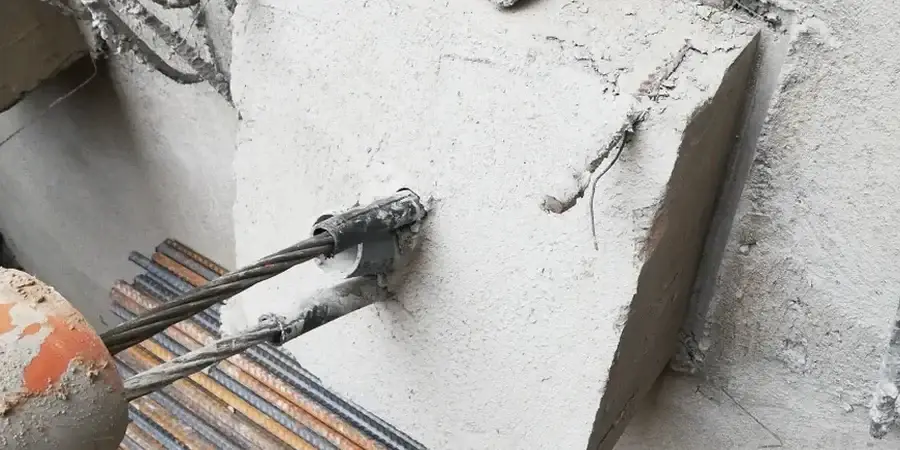
We have seen too many shoring failures in Long Beach that trace back to one assumption: that a single row of passive anchors will hold in saturated sand behind a tidally influenced bulkhead. The harbor area and downtown zones sit on young Holocene deposits where groundwater fluctuates with the San Gabriel River level and harbor tides — a condition that makes anchor creep a real risk if the bonded length is not designed beyond the active failure wedge plus a safety buffer for pore pressure variation. For deep excavations along Ocean Boulevard or retention structures near the Port of Long Beach, the difference between a working system and a costly remedial job often lies in how the unbonded length is calculated under ASCE 7 seismic load combinations. We integrate the site-specific SPT data from our SPT drilling program directly into the anchor load-transfer analysis, ensuring that the grout-to-ground bond stress values reflect the actual fine-grained sand layers present at the project depth, not a generic textbook range.
In Long Beach, anchor bond length is not just about pullout — it is about keeping the unbonded zone clear through layers that want to collapse.
Relevant standards
ASCE 7-22 (Minimum Design Loads and Associated Criteria for Buildings and Other Structures), IBC 2024 (International Building Code, Chapter 18 — Soils and Foundations), PTI DC35.1-20 (Recommendations for Prestressed Rock and Soil Anchors), ASTM A416/A416M (Standard Specification for Low-Relaxation, Seven-Wire Steel Strand for Prestressed Concrete)
Common questions
How much does an active/passive anchor design cost for a project in Long Beach?
For a single-family lot or small commercial excavation with three to five tieback rows, the anchor design package typically ranges between US$950 and US$3,420, depending on the number of test anchors required, the complexity of the subsurface profile, and whether the project is within the Coastal Zone requiring additional corrosion protection analysis.
What is the difference between active and passive anchors in a shoring wall?
An active anchor is prestressed — we apply a lock-off load after the grout reaches strength, which immediately engages the anchor and limits wall deflection. Passive anchors are not prestressed; they only develop resistance when the wall moves and the ground strains. In Long Beach, we specify active anchors for nearly all tieback walls deeper than 12 feet because the allowable lateral deflection under adjacent structures along streets like Pine Avenue or Atlantic Boulevard is typically under 1 inch.
How close to the shoreline can you install grouted anchors without corrosion concerns?
Within 1,500 feet of the mean high tide line, we follow PTI Class I corrosion protection requirements, which means each strand has a corrugated plastic duct filled with grout over the full length, plus an outer encapsulating duct over the bond length. We also use epoxy-coated bearing plates and trumpets at the anchorage head. This double-corrosion-protection system is designed to meet the 75-year service life requirement in an aggressive marine environment.
Do you perform the load testing, or just the anchor design?
We provide the design and the complete proof testing protocol, including the acceptance criteria for creep, the load-hold schedule, and the dial gauge monitoring frequency. The actual pulling is usually performed by the specialty anchor contractor, but we are on-site during the first two proof tests to verify that the load-displacement curve does not indicate a bond failure or an undersized unbonded length — a situation we have caught more than once in the layered soils near the Long Beach Convention Center.