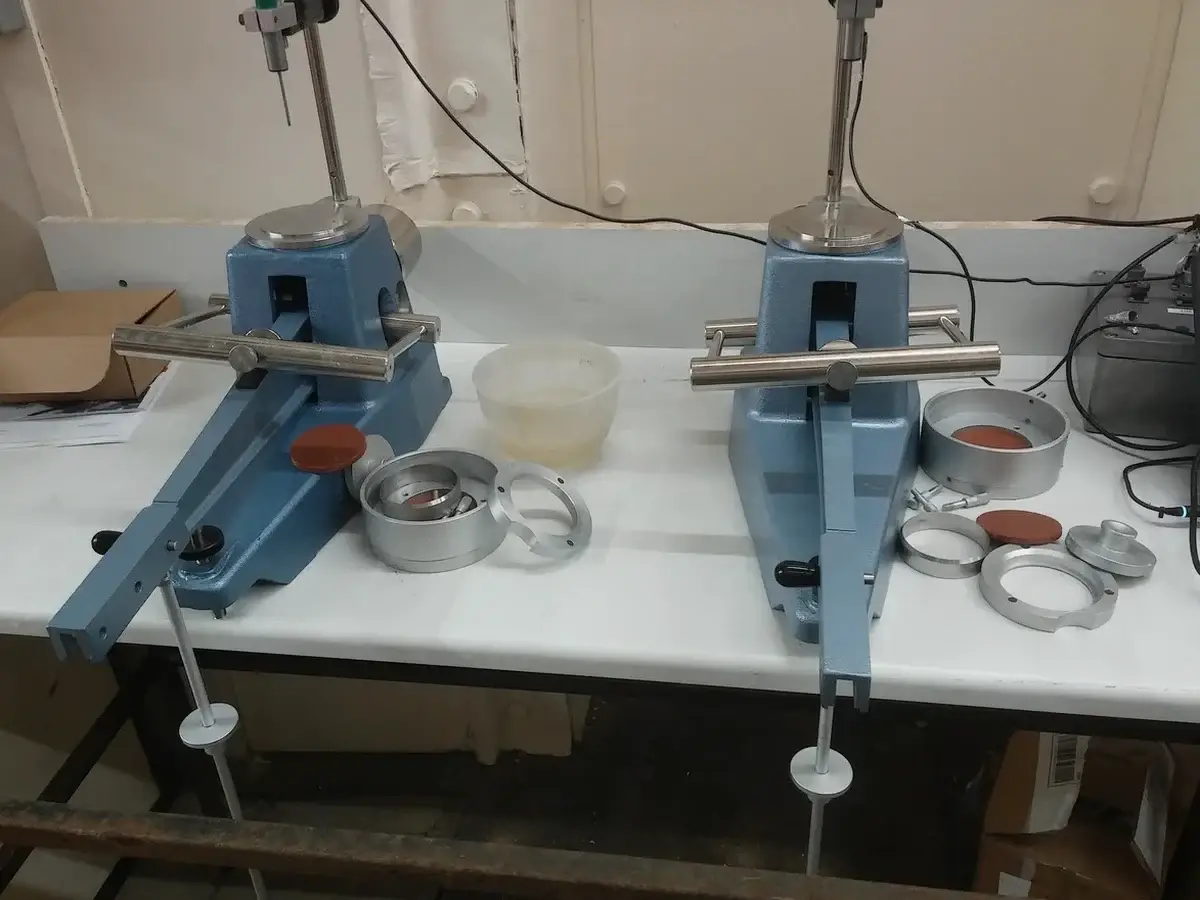
The soil makeup shifts dramatically between Long Beach neighborhoods. The sandy loam near the Los Cerritos Wetlands bears little resemblance to the silty clay deposits in North Long Beach, where the old floodplain of the Los Angeles River left behind fat clays with high plasticity that can wreck a foundation if nobody checks. The city's elevation runs from sea level up to about 170 feet atop Signal Hill, and that variation comes with a maze of soil types. Atterberg limits testing cuts through the guesswork. It gives the liquid limit, plastic limit, and plasticity index of the fine-grained fraction, so the geotechnical engineer knows exactly how the soil will behave when it gets wet. In a coastal city like Long Beach, where groundwater sits high and irrigation is constant, skipping this test is asking for trouble. We run the procedure under ASTM D4318 with calibrated Casagrande cups and a precision rolling device, delivering results that feed directly into the Unified Soil Classification System (USCS). Contractors working near the Port of Long Beach or in the Alamitos Heights area often pair this with a grain size analysis to get the full gradation curve and lock in the USCS symbol without ambiguity.
A plasticity index above 25 in Long Beach's coastal clays is a clear signal to revisit the foundation design before the first footing is poured.
How we work
The Casagrande cup sits on a dense rubber base inside our mobile lab, calibrated to drop exactly 10 mm at 120 blows per minute. The technician works the soil paste into the brass cup, cuts a standard groove with the ASTM grooving tool, and counts the blows until the groove closes. That number gives the liquid limit. For the plastic limit, the same technician rolls threads of soil on a ground-glass plate until they crumble at roughly 3 mm diameter. The difference between those two numbers is the plasticity index. In Long Beach's older districts like Willmore City, we find silts with a plasticity index under 10, which means they drain reasonably well but lose strength fast when saturated. In the tight clay pockets around Recreation Park, values jump above 30, signaling expansive behavior that demands engineered fill or lime treatment. The whole test runs on material passing the No. 40 sieve, so we wet-sieve the sample first to strip out the sand fraction. Every step follows ASTM D4318, and the data goes straight into the boring log alongside SPT blow counts and moisture content.
Local geotechnical context
Long Beach grew fast after the 1933 earthquake, and much of the early expansion filled in marshland and tidal flats without modern compaction standards. A lot of those old fill zones sit in West Long Beach and the Wrigley area, where developers in the 1940s and 1950s placed silty clay dredged from the harbor without testing its plasticity. The problem shows up decades later: sidewalks tilt, slab floors crack, and retaining walls lean outward. High-plasticity clay swells in winter rains and shrinks during dry Santa Ana stretches, cycling year after year. Atterberg limits testing on a representative sample tells you whether that soil is a CL (lean clay) or a CH (fat clay) under the USCS. Fat clays with a liquid limit above 50 and a plasticity index above 25 are the red flag. They move too much for shallow footings and can push lateral loads on basement walls that nobody planned for. The lab report gives the numbers, but the real value is the warning: either remove and replace the material, or design the foundation to handle the volume change.
Relevant standards
ASTM D4318-17e1 Standard Test Methods for Liquid Limit, Plastic Limit, and Plasticity Index of Soils, ASTM D2487-17 Standard Practice for Classification of Soils for Engineering Purposes (Unified Soil Classification System), IBC 2024 Chapter 18 Soils and Foundations, ASCE/SEI 7-22 Minimum Design Loads and Associated Criteria for Buildings and Other Structures
Common questions
What is the difference between liquid limit and plastic limit?
The liquid limit is the water content where soil changes from plastic to liquid behavior, measured with the Casagrande cup at 25 blows. The plastic limit is the water content where the soil crumbles when rolled into a 3 mm thread. The gap between them, the plasticity index, tells you how sensitive the soil is to moisture changes.
How much does Atterberg limits testing cost in Long Beach?
A single-point Atterberg limits test (liquid limit, plastic limit, and plasticity index) typically runs between US$70 and US$100 per sample. The exact cost depends on the number of samples and whether it is bundled with grain size analysis or other classification tests.
Which Long Beach soil types benefit most from Atterberg testing?
Fine-grained soils like the silty clays in North Long Beach and the old fill zones in West Long Beach. These materials often have high plasticity that affects foundation performance. Sandy soils with very few fines generally do not require Atterberg testing.
How long does it take to get results back?
Standard turnaround is 3 to 5 business days from the day the sample arrives at the lab. Rush processing is available for time-sensitive projects when arranged in advance.
What sample quantity is needed for the test?
We need about 150 grams of material passing the No. 40 sieve. For a typical Shelby tube or bag sample, that means roughly 500 grams of bulk soil so we have enough fines after wet sieving. The team can guide you on sample handling if needed.