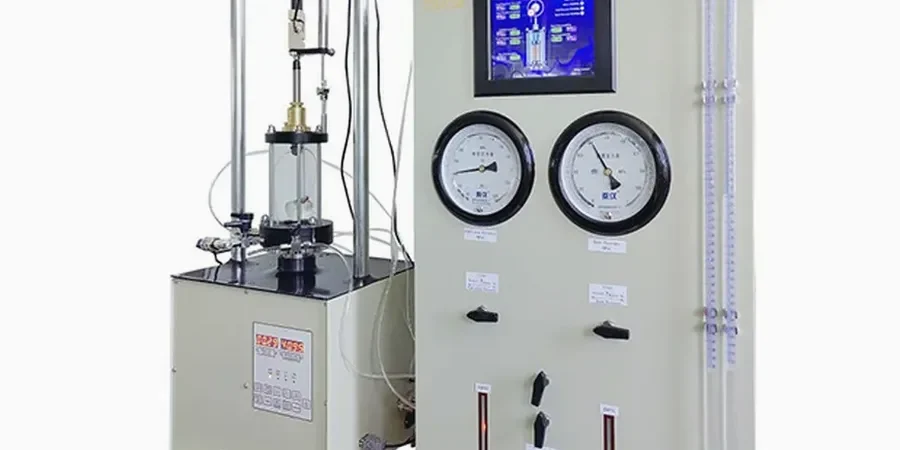
The soil conditions in Long Beach shift dramatically depending on where you stand. Up in Bixby Knolls and Signal Hill, you're dealing with relatively stiff Pleistocene deposits—dense sands and silts that have been sitting there for thousands of years. But head south toward the Port, downtown, or Naples Island, and it's a completely different story: young Holocene alluvium, bay mud, and liquefiable layers deposited by the Los Angeles River and San Gabriel River over centuries. That contrast matters when you're designing a deep foundation or evaluating site response. A standard penetration test gives you blow counts, sure, but for critical infrastructure near the waterfront you need the full stress-strain picture. This is where the triaxial test becomes non-negotiable—it replicates in-situ confining pressures and drainage conditions so the design team knows exactly how the soil will behave under load, not just how it sounds when you hit it with a hammer.
In Long Beach's bay mud environment, assuming drained parameters where undrained conditions govern is the fastest path to a foundation failure.
Local geotechnical context
The triaxial frame itself is a compact machine—a load frame standing about five feet tall with a hydraulic actuator at the base and a triaxial cell clamped between the loading platens—but the real precision lives in the pressure control panel beside it. Three digital regulators manage cell pressure, back pressure, and pore pressure independently, and the whole setup sits on a vibration-isolated bench inside our Long Beach lab. The biggest risk we see on projects here isn't the equipment; it's sample disturbance between the field and the lab. A Shelby tube extracted from 60 feet down in the Terminal Island fill, bounced across three freeways in August heat, can arrive with micro-fractures that completely invalidate the effective-stress parameters. That's why we insist on field-to-lab chain of custody with temperature logs, and why we reject specimens showing visible desiccation or extrusion damage before the membrane even goes on. A bad triaxial sample produces numbers that look plausible but lead to unconservative designs—and in a seismic zone like Long Beach that's a liability nobody can afford.
Common questions
How much does a triaxial test cost for a Long Beach project?
A single triaxial test—UU, CU, or CD—typically runs between US$1,700 and US$2,480 depending on the test type, specimen preparation requirements, and reporting turnaround. CU tests with pore pressure measurement sit at the higher end because of the additional saturation and consolidation stages. We provide firm quotes once we know the number of specimens and the target confining pressures.
Which triaxial test type do I need for a site near the Port of Long Beach?
Most port-area projects in Long Beach require both UU and CU tests. UU gives quick total-stress parameters for short-term bearing capacity during construction on saturated bay mud. CU with pore pressure measurement provides effective-stress friction angles and cohesion intercepts for long-term stability analysis and any loading case where drainage can occur. If you are analyzing a slope or a retaining structure with free-draining backfill, CD testing may also be warranted for drained friction angles.
How long does it take to get triaxial test results?
Standard turnaround is seven business days from the date we receive undisturbed samples in the lab. CU tests take longer than UU because of the saturation and consolidation phases—each can run 24 to 72 hours depending on soil permeability. We offer a four-day expedited option for an additional fee when the construction schedule demands it. We also email preliminary stress-strain curves as soon as the test completes, before the full report is finalized.