← Home · Laboratory

Grain Size Analysis (Sieve + Hydrometer) in Long Beach

Together, we solve the challenges of tomorrow.

LEARN MORE →

With over 460,000 residents living atop the seismically active Los Angeles Basin, Long Beach demands precise geotechnical data before any foundation is poured. Our grain size analysis delivers that precision, quantifying the full particle size distribution from coarse gravel down to sub-2-micron clay colloids. The city sits on a complex mix of Recent alluvium, old marine terraces, and artificial fill—materials whose engineering behavior hinges on gradation. Whether you are designing deep foundations for a downtown high-rise near the 7.2-meter subsidence zone or evaluating liquefaction susceptibility along the Port of Long Beach, a complete sieve and hydrometer test is non-negotiable. We run every sample through ASTM D2487 classification so you know exactly what you are building on. For projects requiring in-situ strength correlation, we often pair this with SPT drilling to link gradation curves directly to blow counts and soil behavior type.

A single grain size curve can reveal whether your Long Beach site is a liquefiable sand, a compressible silt, or a stable gravel—before you excavate a single cubic yard.

How we work

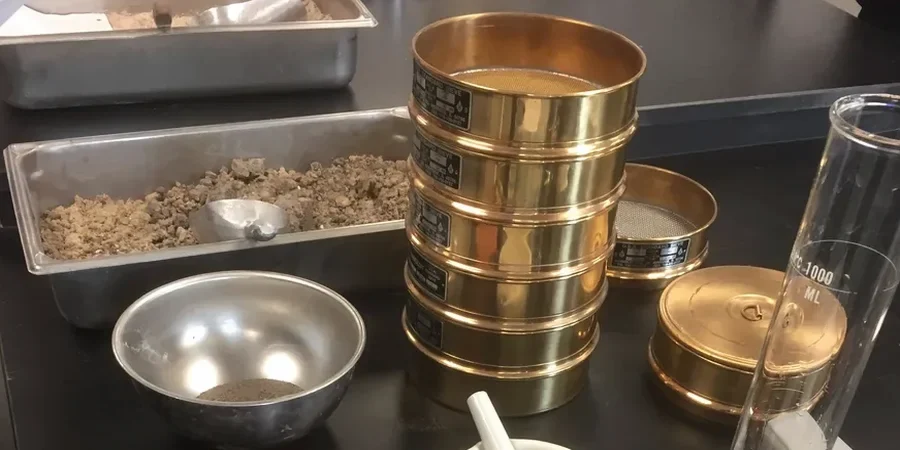
The Los Angeles Basin floor beneath Long Beach is dominated by Holocene alluvium interbedded with estuarine deposits—fine sands, silts, and clays that are notoriously difficult to classify by feel alone. A proper grain size analysis reveals the true story. We start with the mechanical sieve stack per ASTM D6913, separating the coarse fraction from gravel to No. 200 sieve (75 µm). The minus-200 material then undergoes hydrometer testing following ASTM D7928, using a 152H hydrometer calibrated for the specific gravity of your soil. This two-stage process yields a continuous curve from 75 mm down to 0.001 mm, capturing the critical silt-clay transition that governs drainage, compressibility, and cyclic mobility potential. For complete plasticity characterization, the gradation data is routinely interpreted alongside Atterberg limits to place the soil on Casagrande's plasticity chart—a step required by ASCE 7 for seismic site class determination.
Grain Size Analysis (Sieve + Hydrometer) in Long Beach
Technical reference image — Long Beach

Local geotechnical context

When you skip a full hydrometer analysis on Long Beach silty sands and rely only on a sieve stack, you are leaving the most reactive fraction of the soil uncharacterized. The fines content—that minus-200 material—is what controls whether a saturated sand will liquefy during a seismic event on the Newport-Inglewood Fault. We have pulled samples from sites less than a mile from the Long Beach Airport where the clay fraction varied from 8% to 22% across a single boring, completely changing the liquefaction susceptibility classification per Boulanger and Idriss (2014) triggering procedures. A sieve-only curve would have missed that difference entirely. The IBC requires Site Class determination using the upper 30 meters of stratigraphy, and without hydrometer data on the fine-grained layers, you risk misclassifying the site—leading to overly conservative or dangerously unconservative design ground motions.

Need a geotechnical assessment?

Reply within 24h.

Email: info@geotechnicalengineering1.com

Technical data

ParameterTypical value
Coarse fraction methodMechanical sieving, ASTM D6913
Fine fraction methodHydrometer (152H), ASTM D7928
Particle size range75 mm to 0.001 mm (clay colloids)
Sample mass (coarse)500 g to 5 kg, depending on D_max
Dispersing agentSodium hexametaphosphate, 40 g/L solution
Classification standardASTM D2487 (Unified Soil Classification)
Reporting parametersD10, D30, D60, Cu, Cc, % gravel/sand/silt/clay

Related services

01

Full Sieve + Hydrometer Package

Combined ASTM D6913 and ASTM D7928 analysis on a single sample. Includes oven-dry moisture content, specific gravity determination, and a complete gradation plot with USCS classification per ASTM D2487. You receive the percent gravel, sand, silt, and clay fractions, plus Cu and Cc values ready for filtration and drainage design.

02

Wash Sieve with Hydrometer

For silty sands and sandy silts where the fines percentage is critical. We wash the sample over a No. 200 sieve, oven-dry both fractions, sieve the retained material, and run a full hydrometer on the fines. This method eliminates particle agglomeration errors and gives you the true sand-silt split needed for liquefaction triggering analysis per Idriss and Boulanger.

Relevant standards

ASTM D6913 - Standard Test Methods for Particle-Size Distribution (Gradation) of Soils Using Sieve Analysis, ASTM D7928 - Standard Test Method for Particle-Size Distribution (Gradation) of Fine-Grained Soils Using the Sedimentation (Hydrometer) Analysis, ASTM D2487 - Standard Practice for Classification of Soils for Engineering Purposes (Unified Soil Classification System), ASCE 7-22 - Minimum Design Loads and Associated Criteria for Buildings and Other Structures, Chapter 20 (Site Classification), 2024 International Building Code (IBC), Section 1613 (Earthquake Loads)

Common questions

What does a grain size analysis cost in Long Beach?

A combined sieve and hydrometer test typically runs between US$100 and US$200 per sample, depending on whether specific gravity testing is included and how many sieves are required in the stack. Expedited turnaround adds a surcharge.

How long does a sieve and hydrometer test take?

Standard turnaround is 5 to 7 business days. The hydrometer portion alone requires a minimum 24-hour sedimentation period, plus temperature-controlled curing of the dispersed suspension. Rush processing in 3 days is available if coordinated in advance.

Why do I need a hydrometer test if I already have sieve results?

The sieve stack stops at the No. 200 sieve (75 microns). Everything passing that sieve—silts and clays—is unquantified without hydrometer analysis. In Long Beach, where silty sands and sandy silts dominate the shallow stratigraphy, the fines content directly controls liquefaction susceptibility, drainage behavior, and compressibility. ASCE 7 Site Class determination requires knowing the full gradation of fine-grained layers.

What sample size do you need for a complete grain size analysis?

We need a minimum of 500 grams of dry soil for a combined sieve and hydrometer test, though 1 to 2 kilograms is preferred if gravel is present. The sample must be representative of the stratum in question—bagged Shelby tube samples, SPT split spoon samples, or bulk grab samples all work. We can run the test on disturbed material, so field sampling does not require undisturbed preservation.
Location and service area

We serve projects in Long Beach and surrounding areas.

View larger map