← Home · Seismic

Base Isolation Seismic Design in Long Beach

Together, we solve the challenges of tomorrow.

LEARN MORE →

ASCE 7-22 and the California Building Code set strict seismic drift limits that conventional fixed-base structures in Long Beach often struggle to meet without costly overdesign. The city sits atop the fault-bounded Los Angeles Basin, where deep alluvial deposits amplify long-period ground motion in ways that punish rigid buildings. Our laboratory team supports base isolation seismic design by characterizing the elastomeric and sliding bearing properties that ASCE 7 Chapter 17 demands, running full-scale prototype tests in our accredited facility. For projects near the Port of Long Beach on artificial fill, we pair isolation system verification with a liquefaction assessment to confirm that the subgrade won't lose bearing during a design-level event. We also recommend a seismic microzonation study when the site straddles mapped fault zones, feeding accurate spectral ordinates directly into the isolation system model.

Getting the isolator properties wrong by 10 percent can double the residual drift — our lab testing catches that before the bearings are cast.

How we work

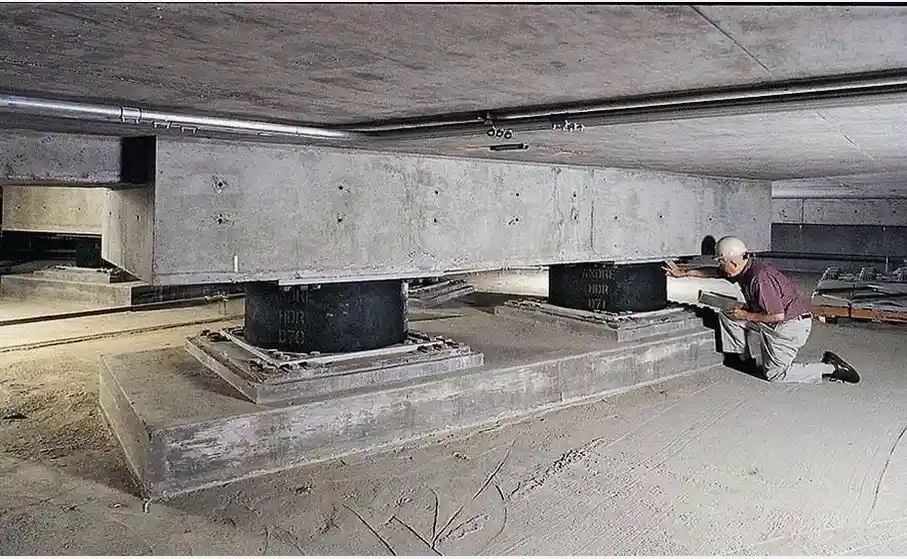
Long Beach began its modern expansion on the drained wetlands of the Los Angeles River floodplain, and the 1933 Long Beach earthquake exposed the vulnerability of unreinforced masonry on soft ground, rewriting California's seismic codes. That history still shapes geotechnical assumptions: many downtown parcels and coastal lots sit on Holocene sediments that transmit high-acceleration, long-period waves. Base isolation seismic design shifts the structural period away from that damaging range, but the isolators must be validated against site-specific displacement demands. Our lab performs cyclic shear testing of lead-rubber and high-damping rubber bearings under axial loads that mirror the column reactions calculated by the structural engineer. We also run friction pendulum slider tests measuring velocity-dependent coefficients through the full range of motion prescribed by ASCE 7 protocols.
Base Isolation Seismic Design in Long Beach
Technical reference image — Long Beach

Local geotechnical context

Long Beach lies within 5 miles of the Newport-Inglewood fault — the same structure that produced the 1933 M6.4 event — and the Palos Verdes fault runs offshore capable of M7.3 ruptures. A non-isolated mid-rise on the soft alluvium south of Willow Street can experience story drifts exceeding 2 percent during a 475-year return period event, triggering costly nonstructural damage even if collapse is prevented. Base isolation seismic design cuts those drifts to under 0.5 percent, but the isolation gap must accommodate the full MCE displacement plus an adequate moat clearance. Our lab provides the hysteresis loops that the peer reviewer will demand, showing that damping remains above 15 percent through the third cycle of loading. Without that data, the plan checker at City Hall simply won't approve the construction permit.

Need a geotechnical assessment?

Reply within 24h.

Email: info@geotechnicalengineering1.com

Technical data

ParameterTypical value
Test standard for elastomeric bearingsASCE 7-22 §17.2 / AASHTO LRFD §14
Maximum shear strain capacity tested300% to 650%
Axial load range in prototype testing50 kip to 3,200 kip
Slider friction coefficient measurement0.02 to 0.12 (velocity-dependent)
Required spectrally-matched ground motionsMinimum 11 pairs per ASCE 7
Common isolator types validatedLRB, HDRB, FPS, triple pendulum
Test temperature range-10°F to 120°F

Related services

01

Prototype Bearing Testing

Full-scale cyclic shear and compression testing of isolators under ASCE 7-required loading protocols, with real-time hysteresis plotting.

02

Bearing Production Quality Control

Routine factory audit testing of production bearings for shear modulus, damping ratio, and compression stiffness per lot.

03

Slider Characterization

Friction pendulum testing at velocities from 1 to 40 in/sec to map the velocity-pressure-degradation surface for the design report.

04

Seismic Gap Analysis Support

We supply the displacement demand data that the architect uses to detail moat covers and utility crossings at the isolation plane.

Relevant standards

ASCE 7-22 Minimum Design Loads and Associated Criteria for Buildings and Other Structures, IBC 2024 (California Building Code, Title 24, Part 2), AASHTO LRFD Bridge Design Specifications, 10th Edition (seismic isolation provisions), ASTM D4014 Standard Specification for Plain and Steel-Laminated Elastomeric Bearings for Bridges

Common questions

How much does base isolation testing cost for a Long Beach project?

Prototype testing for a typical mid-rise runs between US$3,980 and US$8,880 depending on the number of isolator types, the displacement range, and whether bidirectional characterization is required. We provide a fixed-price quote after reviewing the structural drawings and the isolation schedule.

Does ASCE 7 require prototype testing for every isolated building?

Yes — ASCE 7-22 §17.8 mandates that at least two full-size prototypes of each isolator type be tested under the loading history derived from the site-specific response spectrum. The City of Long Beach plan check enforces this strictly, and peer review panels won't waive it.

What ground motion records do you use for Long Beach sites?

We work with the structural engineer's spectrally matched set, typically 11 pairs scaled to the MCEr hazard level. We pull records from the PEER NGA-West2 database prioritizing events on the Newport-Inglewood and Palos Verdes fault systems to capture basin effects.
Location and service area

We serve projects in Long Beach and surrounding areas.

View larger map