← Home · Investigation

SPT (Standard Penetration Test) Services in Long Beach

Together, we solve the challenges of tomorrow.

LEARN MORE →

Long Beach sits at roughly 30 feet above sea level, with a population exceeding 450,000—the seventh-largest city in California. The 1933 Long Beach earthquake, a magnitude 6.4 event centered just offshore, reshaped local building codes forever. Today, every foundation design in the area must reckon with the complex alluvial and estuarine soils beneath the surface. The Standard Penetration Test remains the backbone of that investigation: a direct method to log stratigraphy, retrieve disturbed samples, and measure blow counts that feed directly into bearing capacity and settlement calculations. For projects in the Alamitos Bay area or near the Port complex, we pair SPT data with liquefaction screening to flag potentially unstable sand layers before a single pile is driven.

In Long Beach, a 10-foot difference in boring location can mean the difference between dense alluvium and liquefiable channel fill—SPT spacing matters.

How we work

The urban expansion eastward from the LA River toward Signal Hill triggered decades of fill placement over former marshlands—conditions that demand careful interpretation of penetration resistance. Our field crew operates a CME-75 drill rig equipped with an automatic trip hammer calibrated to ASTM D1586, ensuring the 140-pound weight drops a true 30 inches on every blow. Each 18-inch split-spoon drive is logged in 6-inch increments, with the N-value derived from the final 12 inches of penetration. Where refusal occurs above 50 blows, the boring log notes the exact depth and partial penetration.
For contaminated sites or brownfield redevelopment near the former Douglas Aircraft plant, we coordinate with test pits to visually confirm fill composition before deploying the drill rig. When the subsurface profile demands continuous data, a CPT test can supplement SPT results to refine friction ratios and pore pressure dissipation trends without sample disturbance.
SPT (Standard Penetration Test) Services in Long Beach
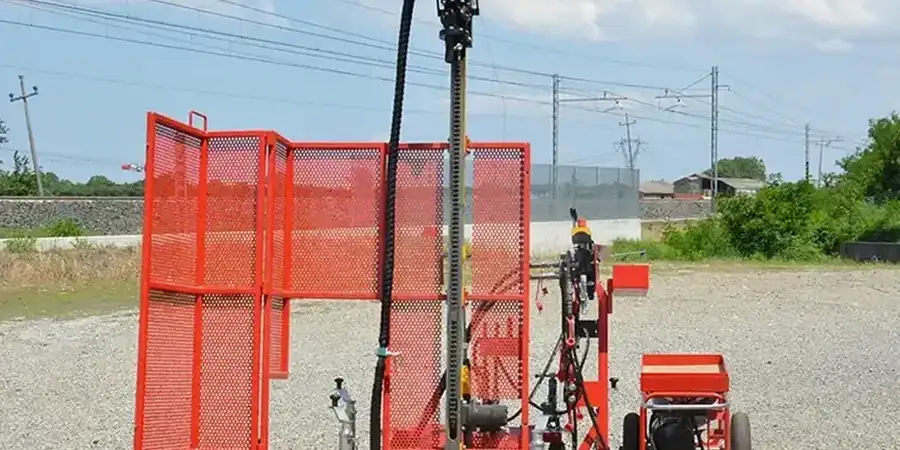
Technical reference image — Long Beach

Local geotechnical context

A common mistake on infill projects in Long Beach is assuming that refusal at shallow depth indicates a competent bearing layer. In the coastal plain, refusal often means hitting a cobble or a thin cemented lens within a much softer matrix—not a continuous stratum. Relying on a single boring with high refusal can lead to differential settlement and cracked slabs within the first five years. Our logs flag any refusal event and recommend a CPT test or core barrel advancement to verify the true thickness of the competent material. Another risk: ignoring energy efficiency corrections (N60) when correlating to liquefaction charts. Seed & Idriss-based evaluations demand corrected blow counts; raw N-values can overestimate resistance by 20-30%, leaving a project exposed to seismic vulnerability that the 1933 earthquake taught us to avoid.

Need a geotechnical assessment?

Reply within 24h.

Email: info@geotechnicalengineering1.com

Technical data

ParameterTypical value
Standard ReferenceASTM D1586 / AASHTO T 206
Hammer TypeAutomatic trip, 140 lb, 30-inch drop
Sampler DimensionsSplit-spoon: 2.0 in OD, 1.5 in ID, 18-24 in length
Blow Count Recording6-inch increments (N = sum of 2nd + 3rd increments)
Sampling IntervalEvery 5 ft or at stratum change
Borehole Diameter4 to 8 inches per project requirements
Energy Correction60% energy ratio (N60) per Seed & Idriss methodology

Related services

01

Liquefaction Potential Screening

Corrected N60 values are plotted against Cyclic Stress Ratio curves per Seed & Idriss and the NCEER workshop guidelines. Reports include factor of safety calculations for each critical layer beneath the groundwater table.

02

Boring Log Preparation and Foundation Recommendations

Logs drafted to CAD standards include USCS classification per ASTM D2487, water level measurements, and SPT N-values. The geotechnical report provides allowable bearing pressures for footings and deep foundation alternatives per IBC Chapter 18.

Relevant standards

ASTM D1586: Standard Test Method for SPT and Split-Barrel Sampling of Soils, ASTM D2487: Standard Practice for Classification of Soils (USCS), ASCE 7-22: Minimum Design Loads and Associated Criteria for Buildings, IBC 2024 (California Building Code adoption with amendments), ASTM D6066: Standard Practice for Determining N60 for Liquefaction Assessment

Common questions

What is the typical cost of an SPT boring in Long Beach?

Mobilization, drilling, sampling, and a summary log for a standard 30-foot SPT boring in the Long Beach area generally ranges from US$490 to US$660 per boring when scheduled as part of a multi-hole exploration program. Deeper borings, confined access, traffic control requirements near major corridors like Pacific Coast Highway, or expedited turnaround on reports can affect the final figure. We provide a fixed-price proposal after reviewing the site location and depth requirements.

How deep should SPT borings go for a typical commercial building in Long Beach?

For a two- to three-story commercial structure on spread footings, IBC generally requires borings to extend to a depth where the stress increase from the foundation is less than 10% of the existing effective overburden stress—commonly 30 to 40 feet in Long Beach's alluvial soils. If deep foundations are planned, borings must penetrate at least 20 feet below the anticipated pile tip elevation. The presence of liquefiable sand layers may push investigation depths to 50 feet or more beneath the groundwater table, which in coastal Long Beach is often encountered between 8 and 15 feet below grade.

How do you handle SPT refusal in Long Beach's coastal soils?

When refusal occurs—defined as 50 blows for less than 6 inches of penetration—we immediately stop the SPT and switch to a solid-stem auger or core barrel to advance the boring through the obstruction. The refusal depth and partial blow count are recorded on the log with a note indicating the sampler encountered refusal. The material causing refusal is recovered and classified. If refusal is widespread across the site, we typically recommend a cone penetration test (CPT) to profile the dense material continuously, or a larger-diameter bucket auger borehole to sample cobbles and verify whether the refusal represents a continuous competent layer or an isolated obstruction within a softer matrix.
Location and service area

We serve projects in Long Beach and surrounding areas.

View larger map