← Home · Ground improvement

Vibrocompaction Design for Coastal Sandy Sites in Long Beach

Together, we solve the challenges of tomorrow.

LEARN MORE →

When a site sits on Holocene-age beach deposits, standard fill compaction won’t reach the bearing capacity required by the Long Beach building code. The IBC references ASCE 7 for seismic ground motion, and in a port city where the water table often sits within 2 to 3 meters of grade, loose saturated sand becomes a liquefaction risk that insurers flag immediately. Our vibrocompaction designs start from site-specific CPT logs run near Alamitos Bay or the Los Cerritos Channel, converting tip resistance into target relative density curves so the contractor knows exactly how many passes per probe point are needed. We then pair that with grain-size analysis to confirm the clean-sand fraction, because fines content above 12 percent changes the vibratory penetration rate and dictates whether a bottom-feed system is required.
For deeper strata beneath planned warehouse slabs west of the 710 freeway, the design package also cross-checks vibro-replacement feasibility against stone columns where silty interbeds appear in the upper 6 meters, giving the owner a clear cost-versus-performance path before mobilization starts.

In saturated Long Beach sand, vibrocompaction isn’t about making the ground harder—it’s about draining it so it doesn’t liquefy when the next Long Beach earthquake hits.

How we work

Long Beach’s microclimate puts a layer of moisture-retentive marine sand over what are essentially ancient dune deposits, and that contrast drives how we set compaction energy. Morning humidity tends to keep the top 2 to 3 feet damp, which helps surface confinement during initial probe penetration, but the underlying zone often drains rapidly once disturbed. Our grid design accounts for that transition by phasing the compaction sequence: a tighter triangular pattern in the upper 4 meters transitioning to a wider square grid below the capillary fringe. The team validates the design with pre- and post-compaction CPT pairs, measuring cone resistance improvement ratios that typically exceed 2.5 in the target zone. Where the soil profile includes gravel lenses mapped in the Los Angeles Basin alluvium, we incorporate CPT test data to avoid refusal damage to the vibrator tip. The specification package includes compaction depth, probe spacing, vibration frequency range, and hold-time at refusal, all keyed to the grain-size distribution from wash-sieve testing so the field crew never guesses when they’re hitting the design density.
Vibrocompaction Design for Coastal Sandy Sites in Long Beach
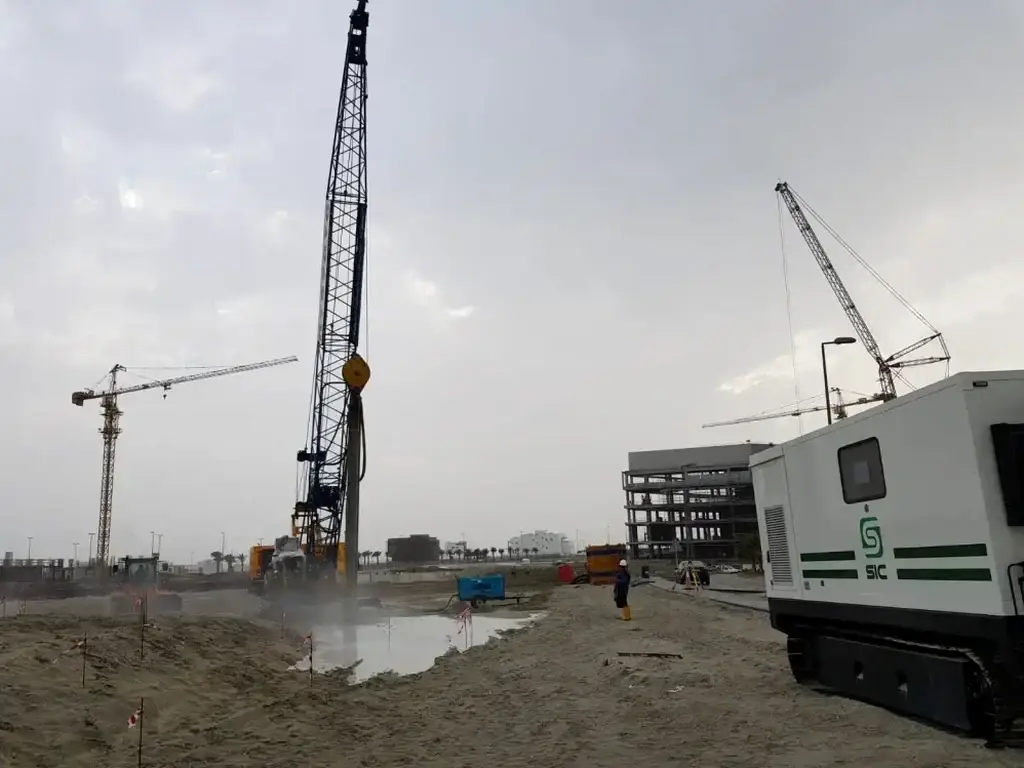
Technical reference image — Long Beach

Local geotechnical context

The most expensive mistake we see in Long Beach is specifying vibrocompaction spacing from a textbook chart without running a CPT through the actual beach sand profile. A grid that is too wide leaves untreated lenses that collapse as soon as the water table rises during winter storms, and the settlement can exceed 2 inches beneath a slab-on-grade—enough to crack utility trenches and rack warehouse racking. The other failure mode is applying a vibrator frequency that matches the natural frequency of the sand column, which can trigger local liquefaction during compaction instead of densifying it. Our design avoids that by modeling the sand’s grain-size curve and computing the resonant column response before setting the operating band. In areas where the Long Beach Oil Field legacy means methane pockets or old sump backfill, we require gas monitoring during compaction and adjust the probe advance rate, because pushing a vibrator through hydrocarbon-contaminated fill creates a safety hazard that no schedule should override.

Need a geotechnical assessment?

Reply within 24h.

Email: info@geotechnicalengineering1.com

Technical data

ParameterTypical value
Applicable standardIBC Section 1805, ASCE 7-22 Chapter 20
Soil gradation referenceASTM D2487 / USCS clean sand (SW, SP)
Grid patternTriangular (upper 4 m), Square (below capillary fringe)
Target relative density70–85% Dr, verified by post-CPT
Fines content cutoff<12% passing No. 200 sieve for vibroflotation
Vibrator frequency range30–50 Hz, electric or hydraulic
Depth verificationPre/post CPT pair, minimum 3 per grid block

Related services

01

CPT-Based Compaction Design

We use cone penetration test data to map loose zones and set probe spacing, depth, and vibration parameters that achieve relative density targets compliant with IBC and ASCE 7.

02

Pre/Post Verification Testing

Paired CPT soundings before and after compaction measure cone resistance improvement ratios, giving the owner a defensible quality-control record for the building department.

03

Grid Optimization and Cost Modeling

We compare triangular and square grid layouts against project budget and schedule, modeling the number of probe points versus time on site so the contractor can bid accurately.

Relevant standards

IBC 2024 (California amendments) Section 1805 – Ground improvement, ASCE 7-22 Chapter 20 – Soil liquefaction and ground motion, ASTM D1586 – Standard Penetration Test (for correlation with CPT), ASTM D2487 – Unified Soil Classification System (grain-size for fines cutoff), ASTM D5778 – CPT electronic friction cone and pore pressure

Common questions

What does vibrocompaction design cost for a typical Long Beach commercial lot?

For a standard commercial parcel in Long Beach—say 20,000 to 50,000 square feet with clean sand to 30 feet—our design package generally runs between US$1,290 and US$5,510, depending on the number of CPT soundings required and whether we need to model gas-mitigation protocols for former oil-field zones. The fee includes the grid layout, compaction specification, and pre/post verification plan.

How do you decide between vibrocompaction and stone columns for a Long Beach site?

The decision hinges on fines content. If the sand has less than 12 percent passing the No. 200 sieve, vibrocompaction is typically more cost-effective and faster. When silt layers exceed that threshold, the vibrator can’t densify effectively, and we shift the design toward stone columns. We always run a grain-size analysis from split-spoon samples before locking in the method.

How long does the design process take once site investigation is complete?

Once we have the CPT logs and lab grain-size curves, we can produce the full vibrocompaction design package in five to seven business days. That includes the grid drawing, compaction sequence, verification protocol, and special provisions the contractor will need for the permit submission.
Location and service area

We serve projects in Long Beach and surrounding areas.

View larger map